
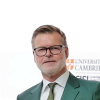
Professor Richard Calland came to South Africa in 1994 to work on a voluntary basis for the ANC’s election campaign, following seven years as a barrister in London. He stayed in South Africa in order to take a position at democracy thinktank Idasa, to head a new parliamentary monitoring and information service during the heady days of the first democratic parliament. In due course he founded or co-founded a number of organisations including the Parliamentary Monitoring Group (PMG), the Open Democracy Advice Centre and CASAC – the Council for the Advancement of the South African Constitution on whose advisory council he still serves.
Following 16 years based at the University of Cape Town as an Associate Professor in Constitutional Law from 2007-2023, he is now Emeritus Associate Professor at UCT and a Visiting Adjunct Professor at the University of Witwatersrand School of Governance. Since 2022, he has led the University of Cambridge Institute for Sustainability Leadership (CISL)’s new Board Leadership programme and in mid-2023 was appointed as Director of CISL’s new Africa programme, from its South African office. Previously, as a Fellow, he was a regular member of faculty on CISL leadership programmes with organisations such as Anglo American, Namdeb, PWC, Tata, the World Bank and African Development Bank.
He has a particular interest in multistakeholder governance, having been an advisor to the Construction Sector Transparency Initiative (CoST) since its inception, arising from his legal specialism in freedom of information. For ten years, he served as a member of the World Bank’s Access to Information Appeals’ Board, and has been consultant to the Green Climate Fund and European Bank of Reconstruction & Development on their respective information disclosure policy reviews.
A prominent political analyst, and a columnist for the Mail & Guardian newspaper in South Africa since 2001, his latest book – The Presidents: From Mandela to Ramaphosa, Leadership in The Age of Crisis – was published in late 2022. Earlier books include Anatomy of South Africa: Who holds the power? (2006), The Zuma Years (2012) and Make or Break: How the next three years will shape South Africa’s next three decades (2016). His debut play – The Brothers, Number One and a Weekend Special – was performed at the Market Theatre in April 2024.
He is a founder partner at political risk consultancy, The Paternoster Group, whose past and present clients include Discovery Health, Anglo American PLC, VWSA, Citadel Wealth, South32, Air Liquide, the New Zealand High Commission and the French Development Agency.

Sibusiso is the Africa programme manager at the University of Cambridge Institute for Sustainability Leadership. Prior to joining CISL, Sibusiso worked in political polling at Afrobarometer. He has experience with a diverse background spanning media, academia, and think tanks. He held key roles at Afrobarometer, focusing on strategic partnerships, communications, and research. A major part of his work focused on the African Union.
Sibusiso Nkomo is CISL’s Programme Manager for the Africa Programme. He manages work streams on Africa executive education, foresight, innovation and CLG Africa. Sibusiso is also a faculty member on the Sustainability Practitioner Programme, FSD Africa Climate Finance Leadership Programme and BSP Africa. He also serves on the CISL foresight strategy group.
Prior to joining CISL, Sibusiso worked in political polling at Afrobarometer. He was a research associate at the University of Cape Town, including the Centre for Social Science Research, then the Institute for Democracy, Citizenship and Public Policy in Africa, and lastly, a doctoral research fellow in the Archive and Public Culture Research Initiative. Sibusiso has published widely, particularly on democratic governance and public policy and media in Africa.
He began his professional journey as a newspaper journalist, specialising in government and political reporting for The Sunday Independent, Cape Argus and Cape Times. Sibusiso has also worked for Good Governance Africa, Afrobarometer and the Institute for Justice and Reconciliation. He has also presented at major governmental organisations including the East African Community, the African Union, African Development Bank, United Nations, the Parliament of the United Kingdom, the South African Government and US Congress etc.
Sibusiso holds a BA and Postgraduate Diploma from Stellenbosch University and a MA from the University of the Witwatersrand, Johannesburg.

Professor Themba Maseko is a steadfast leader who has dedicated his life to serve the country and build a more equitable world. He leverages his diverse experience to lead the Wits School of Governance to produce the next generation of leaders in society and the public sector.
His distinguished career includes being the founding Superintendent-General of the Gauteng Department of Education, former Director General in the departments of Public Work, Public Service and Administration, CEO of Government Communications and Information System and Cabinet Spokesperson.
He is a former Managing Director of Damelin Education Group and Communications Director at Business Leadership South Africa.
Professor Maseko is the Chairperson of Corruption Watch (Chair), a member of the Council for the Advancement of the South African Constitution and a Trustee at the Nelson Mandela Foundation.
Professor Maseko is the author of For my country: Why I blew the Whistle on Zuma and the Guptas. He was awarded for his courage and bravery at the Inaugural Whistleblower awards.
He holds an MBA and a BA LLB, along with a prestigious Senior Executive Programme from Wits Business School and Harvard University.

Susan is deeply passionate about and committed to embedding sustainability thinking, practice, and authentic communications into business, education, and policy towards creating a world where we care about each other and our shared future. She is Managing Director, Responsible Business Consulting. Prior to consulting, Susan was Head, Sustainability & Community Engagement, Standard Chartered Bank Kenya. Before this, she worked with Unilever as Head of Corporate Affairs, East Africa and prior to that with DHL Express as Head of Marketing & Communications East Africa. She has held various management roles with DHL in corporate responsibility and communications in Europe and Asia. Susan also worked with CSR Europe, Europe’s leading business network for CSR, as Senior Programmes Manager leading CSR services delivery, project design and management for CSR Europe’s members.
She has over 20 years’ experience working with multinationals in Africa, Asia and Europe in sustainability and communications. Susan has worked in various leadership and management roles, driving national and regional sustainability strategy, programme delivery, multi-stakeholder partnerships, employee engagement and volunteering, external and internal communications, and crisis communications.
Susan is also an Executive Fellow at Strathmore University, Strathmore Business School, Kenya, and an alumna of the CISL Prince of Wales Business & Sustainability Programme, Stellenbosch.
She holds an Msc. Sustainable Development, with the University of London, SOAS. A bachelor’s degree in business management from Daystar University, Kenya, a Charted Institute of Marketing Diploma in Marketing Communications, a Public Relations Diploma from the Chartered Institute of Public Relations.

Khanyi Mlambo is passionate about driving sustainability and shared value principles for businesses to purposefully pursue sustainable growth while positively impacting customers, society, and the environment. She is the MD of KM ESH consulting, an Independent Sustainability Consultant, a Facilitator, a Transformational Executive Coach and a Speaker. Her career spans over 30 years across multinational businesses, including Old Mutual as Head of Responsible Business, Standard Bank Group, and Corobrik, as an Executive Director and Board member.
She is a Non-Executive Director at Nozala Investment Trust, the Southern African HIV and Aids Collaboration (SAHAC) and Legacy Africa Publishing (LAP). She is a Committee Member of the Institute of Directors SA (Social and Ethics Committee), an associate of the Shared Value Africa Initiative (SVAI), and a Senior Associate at Cambridge Institute of Sustainable Leadership. She is a previous Board Member of the UN Global Compact SA Network, the National Business Initiative (NBI), Motheo Construction Group – Chair of SEEC, South African Women in Construction – Chair, Construction Industry Development Board.
She holds an Honors in Psychology, a Bachelor’s in Applied Social Sciences, a National Diploma in Architecture, and a Post Graduate Diploma in Marketing Management. She attained certificates in Business Management (UCT) and Executive General Management (GIBS) and attended Cambridge's CISL Prince of Wales’s Business & Sustainability Programme. She is a Master’s Degree in Community Psychology candidate.
She co-founded and Chaired the South African Women in Construction (SAWIC) and is key in assisting stakeholders in collaborative efforts to deliver the UN's sustainable development goals.

Raesetsa Hopane is the Executive Education Director (Acting) at the Wits School of Governance (WSG). He holds a Master of Business Administration (MBA) and a Postgraduate Diploma in Business Administration (PDBA) from the Wits Business School, as well as a BSc in Information Technology (specialising in Applied Mathematics) from the University of Pretoria. He is pursuing his doctoral studies in social entrepreneurship. His research interests include social entrepreneurship, social impact, impact financing, and sustainable social enterprises. He has over 14 years of experience in sales and business development in the private and public sectors. His career includes roles at IBM, Lenovo, Telkom, BCX, Gartner, and now WSG. He enjoys coaching and mentoring young student-athletes and helping them shape their careers. At home, he is a husband and father to three kids. One beautiful daughter and two charming boys.

Lindsay is CEO for the Cambridge Institute for Sustainability Leadership which activates leadership globally to transform economies for people, nature and climate.
She brings over 20 years’ experience at the forefront of business and sustainability, challenging, inspiring and supporting senior leaders from multinational businesses, financial institutions and influential organisations to accelerate progress to a sustainable economy.
Lindsay has a track-record of leading significant growth, innovation and impact through building the vision, strategy, structures and capabilities necessary to deliver against organisational purpose. She played a foundational role driving transformative change and has supported CISL’s evolution into the respected international institute it is today.
Working closely with CISL’s leadership team, Lindsay has been key to setting the Institute’s ambitions for impact, its international strategy and organisational purpose. She has also played a key role in developing organisational positions and shaping a foresight agenda in support of CISL’s goals.
Under Lindsay’s guidance as Executive Director for Education, CISL has become the global benchmark for sustainability leadership education. Hundreds of major organisations and thousands of individual leaders globally have gone on to influence change and lead progress, aligning their organisational performance with the delivery of positive outcomes for society.
Lindsay oversaw the Institute’s board, executive and practitioner-level education including its postgraduate programmes, online courses, leadership seminars, customised programmes and advisory services for major clients. She has led significant expansion of CISL’s routes to impact, including innovating in new propositions, collaborations and expansion into new geographies. She has personally led engagements across banking, extractives, retail, utility and manufacturing sectors, as well as with major municipalities and SOEs in China and the Middle East – engagements which have resulted in transformational change and enhanced organisational performance. She has deep experience of harnessing the talents and expertise of leading experts and innovators internationally, building high-performing teams and long-term collaborations to develop leading edge programmes that deliver significant, positive impacts.
Lindsay also led the Institute’s position and contribution to evolving international debates on matters including fossil fuel phase out, business leadership, and the relationship between business and society. She speaks on global trends and the commercial implications for business including the business response to Net Zero transition and leadership for a sustainable future.

Pat is the Founder of The Purpose Business (TPB), Asia’s leading advisory and consultancy who guide leaders to evolve business as a force for good – in the region and beyond. She is also is a Senior Associate at the Cambridge Institute for Sustainability Leadership (CISL) and sits on the Global Steering Committee of the Prince of Wales’s Business & Sustainability Programme. She serves as faculty and tutor across the CISL Executive Education programmes. She sits on the Sanofi Shared Care Collective, an advisory board for the leading consumer healthcare group now known as Opella.
Before TPB, Pat worked across international environmental NGOs before moving to the corporate world- pioneering the Chief Sustainability Role for Ayala Land, the Philippines’ most esteemed land developer and then for Shangri-La Hotels & Resorts as the first Global Head of CSR & Sustainability which became the first Asian hotel chain to be recognised in the Dow Jones Sustainability Index.
Pat is regular keynote speaker and panel moderator on topics including purpose and leadership, responsible business, women’s empowerment and inclusion. She is World Economic Forum Young Global Leader and remains a fellow of the Royal Society of Arts. She is on the board of directors of Ignite Impact Fund Philippines and Enrich, a Hong Kong-based charity dedicated to the financial literacy of migrant domestic workers.
Pat holds an MA in Globalisation & Governance, certificates in Transformational Leadership from the University of Oxford and Global Leadership & Public Policy for the 21st Century from the Harvard Kennedy School.

Ian supports CISL executive, graduate and online training programmes. Formerly he led Sustainability in Product Development with Jaguar Land Rover. At JLR Ian and his team supported the development of large-scale circular economy projects, the use of science to drive sustainable product development and business strategy culminating in the development of JLRs first electric vehicle.
Ian Ellison supports a variety of CISL programmes, including executive, graduate and online training. Formerly he was Chief Engineer for Sustainability with Jaguar Land Rover. At JLR Ian and his team supported the development of large-scale circular economy projects, the use of science to drive sustainable product development and business strategy and the development of JLRs first electric vehicle.
Prior to that Ian was Corporate Responsibility Director for a European JV in the Aerospace and Defence sector. Previous roles with that company included Strategic Change Director and Head of Systems & Strategy. Ian has a degree in Mechanical Engineering. He is a Chartered Engineer, Chartered Management Accountant, Chartered IT Professional and Fellow of the British Computer Society. Ian’s early career included work in the software, electronics and nano-technology sectors.
Ian has been a Tutor on the Value Chain Stream of PCSB since cohort 1. He is also course designer and head Tutor for CISLs Sustainable Supply Chain Management online 8-week course. He is also and alumnus of the PCSB and CISL Masters programme.

Gerry grew up in New Zealand, where he studied physics and maths, and was awarded the first NZ PhD in astronomy. He worked at the Royal Observatory Edinburgh as Senior Research Fellow, before moving to Cambridge in 1984.
Gerry has been successively Advanced Research Fellow, The Royal Society Smithson Fellow at King's College, and John Couch Adams Astronomer, and is now Professor of Experimental Philosophy at the Institute of Astronomy in the University of Cambridge. He leads the effort to understand the structure and origin of our Galaxy and his team has provided us our current understanding of how the masses of stars are distributed at birth.

A circular economy expert with a systems-thinking mindset, Jie Zhou brings 15+ years of experience driving sustainability across industries. Her interdisciplinary and international background, including three master's degrees, allows her to connect the dots between global challenges and empower organisations & startups to create a sustainable future.
Jie has been an intrapreneur since she joined Cambridge Institute for Sustainability Leadership (CISL) in 2021 as a founding Innovation team member, supporting the launch of The Canopy – CISL's incubator and innovation hub. Her work including running accelerator programmes for startups (e.g. Circular Disruptors Accelerator), creating toolkits and training for SMEs to decarbonise (e.g. Climate Fit - SME Climate Hub), partnering with international organisations to build innovation programmes (e.g. Innovation30: Young Climate Innovators Shaping the Future | UNICEF Office of Innovation ), as well as speaking and building Canopy’s global presence at COPs, WEF Davos, and SLUSH etc.
In addition, she also heads the Sino-UK Centre for Sustainability Innovation founded by CISL, acts as a bridge connecting the UK and China's innovation ecosystems. Established in 2021, the Centre fosters collaboration and accelerates the development of sustainable solutions to address critical global challenges. By facilitating knowledge exchange and partnerships, the Centre empowers businesses and entrepreneurs in both countries to drive decarbonization, restore nature, and build more inclusive societies.
Beyond her role at CISL, Jie serves as a research advisor at Newham College (Cambridge), Trustee at Dialogue Earth (London), and Advisor at Undivided VC (Hong Kong), giving back her experiences and insights on a pro bona basis. Driven by her cross-cultural experiences as an ethnic minority, Jie is a passionate DE&I advocate, actively contributing to CISL's Equality Action Planning committee. Her leadership was recognized with the University of Cambridge Vice-Chancellor’s Social Impact Award (2022).

Shruti Kapila is Professor of History and Politics at the University of Cambridge, Director of Studies at Corpus Christi College and Co-Director of Global Humanities Initiative. Her most recent book Violent Fraternity: Indian Political Thought in the Global Age (Princeton University Press, 2021 and Penguin Random House India, 2021) has received praise as a ‘ground-breaking’ book that is tipped to ‘globalise’ the field of political thought. She was awarded an OBE in the King’s Birthday Honours in 2024 for services to the Humanities. Prior to Cambridge, she held a research position at the University of Oxford and was Assistant Professor, in conjunction with a University Chair for Career Development, at Tufts University, Mass., USA.

Ursula Woodburn is Director of CISL’s Europe office and the Corporate Leaders Group Europe. Through her role she supports CISL’s work on systems change and leads the work across CISL’s Europe office, in particular driving corporate support for a climate neutral, nature positive and sustainable economy. She also leads CISL engagement with the We Mean Business Coalition, in particular around EU policy and its links to international policy and work with the Green Growth Partnership, which creates a common space for governments, businesses and parliamentarians to collaborate in support of a greener EU economy.
Ursula joined CISL from Weber Shandwick Brussels, where she led the sustainability practice. She previously worked in the European Parliament and for an environmental NGO and brings more than 18 years of Brussels public affairs and strategic communications experience across energy, climate and transport sectors.
Ursula has a Masters in Development and Governance from the University of Antwerp and studied Archaeology and Anthropology at the University of Cambridge.

Kennedy Mbeva (PhD) is a Research Associate at the Centre for the Study of Existential Risk, at the University of Cambridge. He previously served as a Postdoctoral Research Associate at the Blavatnik School of Government, University of Oxford. Dr Mbeva’s research is on the governance of global catastrophic risk, focusing on geoeconomics and catastrophic climate change.
Dr Mbeva has contributed to high-profile UN scientific reports such as the IPCC AR6 and the Adaptation Gap Report and served on Kenya’s official delegation to the UN Climate Change negotiations. A Kenyan national, he holds a PhD in International Relations (distinction) from the University of Melbourne, and has studied and worked in several continents, including Africa, Europe, Asia, and Australia. His latest book is Africa’s Right to Development in a Climate-Constrained World (Palgrave Macmillan, 2023, co-authored).

Andrew Styles is a physical oceanographer who studies basin-scale and global-scale circulations and their behaviours in climate models.
He leads the adjoint component of OceanBound, an ambitious project investigating the role of ocean boundary pressures in the global ocean. As an adjoint modeller, Andrew uses the ECCO state estimate to identify which external forces the boundary pressures are most sensitive to.
Andrew completed his PhD at the University of Oxford in 2023, where he focused on the dynamics of the Weddell Gyre and its influence on Southern Ocean ventilation. His research combined idealised model design, diagnostic method development, Lagrangian trajectory analysis, and theoretical approaches.
He continues to explore the dynamics of the Weddell Gyre and maintains a close collaboration with the SO-CHIC project (Southern Ocean–Carbon and Heat Impact on Climate).